
The best strategic thinking books are Thinking, Fast and Slow by Daniel Kahneman for judgement, Decisive by Chip and Dan Heath for decision process, Thinking in Systems by Donella Meadows for complexity, Superforecasting by Philip Tetlock for uncertainty and Good Strategy Bad Strategy by Richard Rumelt for applying it to strategy.
As an Amazon Associate I earn from qualifying purchases. Links to Amazon on this page are affiliate links. This does not change the price you pay.
Strategic thinking is the habit of stepping back from day-to-day problems to see the bigger picture: what is changing, what really matters and which choices will make the most difference over time. It can be learned, and books are one of the best ways to start. This list covers 12 books that sharpen different parts of strategic thinking, from avoiding bias and handling uncertainty to seeing systems and applying the ideas to business strategy.
Quick picks: the best strategic thinking books
| Book | Author | Best for |
|---|---|---|
| Thinking, Fast and Slow | Daniel Kahneman | Anyone who makes high-stakes decisions |
| Decisive | Chip Heath and Dan Heath | Leaders who want a simple process for better decisions |
| Thinking in Bets | Annie Duke | Anyone who decides under uncertainty |
| Superforecasting | Philip E. Tetlock and Dan Gardner | Leaders who make forecasts, plans or investment calls |
| The Black Swan | Nassim Nicholas Taleb | Leaders responsible for risk and long-term planning |
| Thinking in Systems | Donella H. Meadows | Leaders dealing with complex, interconnected problems |
| The Great Mental Models Volume 1 | Shane Parrish and Rhiannon Beaubien | Readers who want a toolkit of thinking models |
| Range | David Epstein | Leaders and professionals with broad or changing careers |
| Seeing What Others Don't | Gary Klein | Leaders who want to encourage insight and original thinking |
| Good Strategy Bad Strategy | Richard P. Rumelt | Leaders who suspect their strategy is really a list of goals |
| The Art of Strategy | Avinash K. Dixit and Barry J. Nalebuff | Leaders who negotiate or compete against thinking opponents |
| Becoming A Strategic Business Leader: The Ultimate All-In-One Guide | Adam Niazi FCCA | Readers who want structured frameworks to organise their strategic thinking |
What is strategic thinking?
Strategic thinking is the ability to understand a complex situation, anticipate how it might change and choose actions that create long-term advantage. It is different from planning, which organises the steps once a direction is chosen. In research published in Harvard Business Review, Schoemaker, Krupp and Howland described strategic leaders as people who anticipate, challenge, interpret, decide, align and learn. The first four of those skills are essentially strategic thinking. My guide to strategic thinking explains the idea in more depth, and strategic thinking in leadership shows how it applies to managers.
Which books help you make better decisions?
Strategic thinking begins with understanding how your own mind works. These three books explain the predictable mistakes people make when judging and deciding, and give practical ways to avoid them.

1. Thinking, Fast and Slow
Daniel Kahneman, 2011
Best for: Anyone who makes high-stakes decisionsNobel laureate Kahneman summarises decades of research with Amos Tversky on how people make judgements. System 1 thinking is fast, intuitive and prone to predictable biases; System 2 is slow, deliberate and lazy. The book explains anchoring, loss aversion, overconfidence, the planning fallacy and more. It is demanding in places, and a few studies it cites have since struggled to replicate, but it changed how many leaders think about decisions.
Key lesson: Your intuition is confident even when it is wrong, so slow down for decisions that really matter.
View on AmazonKahneman received the 2002 Nobel Memorial Prize in Economic Sciences for his work on judgement and decision-making under uncertainty.
2. Decisive
Chip Heath and Dan Heath, 2013
Best for: Leaders who want a simple process for better decisionsThe Heath brothers diagnose four villains of decision-making: narrow framing, confirmation bias, short-term emotion and overconfidence. Their WRAP process counters each one: widen your options, reality-test your assumptions, attain distance before deciding and prepare to be wrong. Packed with examples, it is one of the most usable decision books available. Each chapter ends with clear prompts, so you can apply the process to a live decision as you read, which is the best way to make it stick.
Key lesson: If you only have one option on the table, you have not really made a decision yet.
View on Amazon
3. Thinking in Bets
Annie Duke, 2018
Best for: Anyone who decides under uncertaintyA former professional poker player explains how to make decisions when you cannot know the outcome. Her key warning is against 'resulting', judging a decision by how it turned out rather than by the quality of the thinking. She shows how to express beliefs as probabilities and build a group that challenges your reasoning. Practical and readable. It pairs well with Kahneman for leaders who want something lighter and more hands-on.
Key lesson: Judge decisions by the quality of the thinking, not only by the outcome.
View on AmazonWhich books help you think about uncertainty?
Strategy is always about the future, and the future is uncertain. These two books take opposite but complementary views: Tetlock shows that careful forecasting can be improved, while Taleb warns that the most important events are often impossible to predict.
4. Superforecasting
Philip E. Tetlock and Dan Gardner, 2015
Best for: Leaders who make forecasts, plans or investment callsTetlock's research found that some ordinary volunteers made far more accurate forecasts about world events than experts. This book explains how they do it: breaking questions into parts, starting with base rates, updating beliefs in small steps as evidence arrives, and keeping score. It is an excellent guide to thinking in probabilities instead of confident predictions. The ten commandments for aspiring superforecasters at the end make a handy checklist for planning meetings.
Key lesson: Good forecasters update their views in small steps as new evidence arrives, and keep score.
View on Amazon
5. The Black Swan
Nassim Nicholas Taleb, 2007
Best for: Leaders responsible for risk and long-term planningTaleb explores rare, high-impact events that nobody predicted but everyone explains afterwards. He argues that we underestimate extreme events, overtrust forecasts and models, and should build robustness rather than relying on prediction. It is opinionated and sometimes combative, but its warnings about risk models feel more relevant after every crisis. Read it for the mindset rather than a set of tools, and pair it with something more practical, such as Superforecasting or Thinking in Bets.
Key lesson: Prepare for what you cannot predict by building resilience, not by trusting forecasts.
View on AmazonWhich books help you see the bigger picture?
Strategic thinkers see connections others miss. These four books build that ability: understanding systems, using a range of mental models, drawing on broad experience and generating insight.
6. Thinking in Systems
Donella H. Meadows, 2008
Best for: Leaders dealing with complex, interconnected problemsMeadows, a lead author of The Limits to Growth, wrote this primer to explain how systems behave: stocks, flows, feedback loops and delays. She then describes common traps, such as policy resistance and the tragedy of the commons, and the leverage points where small changes can have big effects. It is short, clear and well illustrated, and makes complex problems easier to reason about.
Key lesson: Look for leverage points in the structure of a system, rather than pushing harder on the symptoms.
View on Amazon
7. The Great Mental Models Volume 1
Shane Parrish and Rhiannon Beaubien, 2019
Best for: Readers who want a toolkit of thinking modelsFrom the team behind the Farnam Street blog, this book explains nine general thinking tools, including the map is not the territory, circle of competence, first principles thinking, thought experiments, second-order thinking, probabilistic thinking, inversion, Occam's razor and Hanlon's razor. Each is short and illustrated with examples. It is a handy toolkit for clearer reasoning. It works best as a book you dip into before a big decision, rather than reading cover to cover in one sitting.
Key lesson: Ask 'and then what?': second-order effects often matter more than the first.
View on Amazon
8. Range
David Epstein, 2019
Best for: Leaders and professionals with broad or changing careersEpstein challenges the idea that early specialisation is the path to success. In complex, unpredictable fields, people with broad experience often outperform specialists because they can draw analogies across domains and adapt when the rules change. The book is a strong argument for varied careers and for leaders who deliberately seek perspectives outside their field. Sport, music and science examples make the argument lively and memorable, even when you disagree with parts of it.
Key lesson: In complex, fast-changing environments, breadth of experience helps you spot patterns specialists miss.
View on Amazon
9. Seeing What Others Don't
Gary Klein, 2013
Best for: Leaders who want to encourage insight and original thinkingKlein, a psychologist known for studying how experts make decisions in the field, investigates where insights come from. He identifies three paths: spotting connections, noticing contradictions and escaping from a flawed assumption when you are stuck. He also shows how organisations unintentionally suppress insight by focusing only on reducing errors. A valuable read for leaders who want more original thinking.
Key lesson: Organisations that only try to reduce errors also tend to reduce insight.
View on AmazonWhich books apply strategic thinking to business strategy?
Finally, these three books take thinking skills and apply them to the strategy of an organisation: diagnosing problems, anticipating competitors and using structured models.
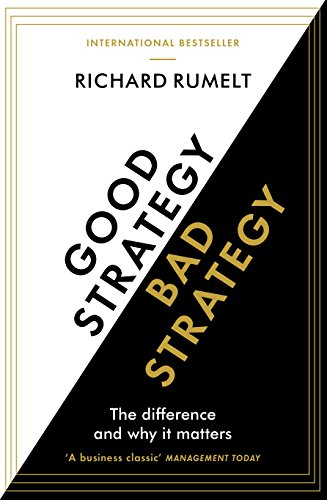
10. Good Strategy Bad Strategy
Richard P. Rumelt, 2011
Best for: Leaders who suspect their strategy is really a list of goalsRumelt, a UCLA professor, argues that most so-called strategies are just goals, slogans or wish lists. Good strategy has a kernel of three parts: a diagnosis of the challenge, a guiding policy for dealing with it and a set of coherent actions. He illustrates this with examples from business and military history and explains sources of power such as leverage, focus and chain-link systems. It is the best modern book on what strategy actually is.
Key lesson: Good strategy starts with an honest diagnosis of the problem, not with ambitious targets.
View on Amazon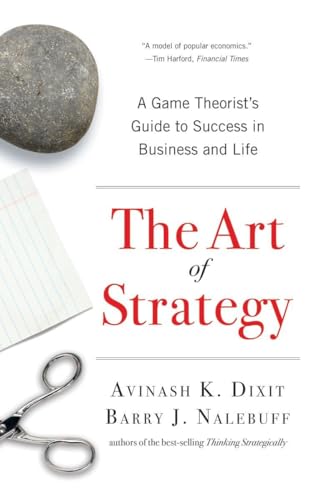
11. The Art of Strategy
Avinash K. Dixit and Barry J. Nalebuff, 2008
Best for: Leaders who negotiate or compete against thinking opponentsTwo economists explain game theory in plain language using examples from business, sport, politics and everyday life. Topics include anticipating rivals' responses, credible commitments, bargaining, auctions and when to cooperate. You do not need maths to follow most of it. It is the best introduction to thinking about strategy as a set of interacting moves rather than a solo plan.
Key lesson: Look forward and reason backward: think through how others will respond before you move.
View on Amazon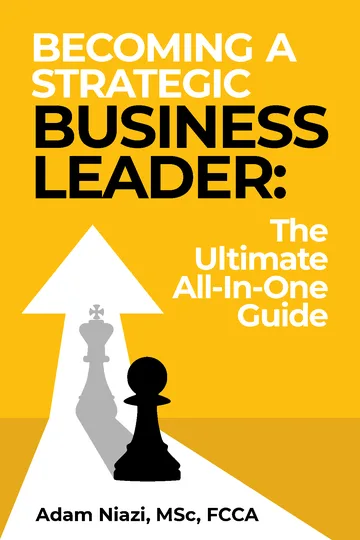
12. Becoming A Strategic Business Leader: The Ultimate All-In-One Guide
Adam Niazi FCCA, 2023
Best for: Readers who want structured frameworks to organise their strategic thinkingStrategic thinking needs structure as well as insight, and this is where my book fits. It is a concise guide to the analytical models that help you organise your thinking about an organisation: environmental analysis, industry analysis, internal capabilities, performance measures, strategic options and how to evaluate them, plus stakeholders and risk. It was written as a revision guide for the ACCA Strategic Business Leader exam, so it is short and practical rather than philosophical. Disclosure: this is my own book.
Key lesson: Frameworks do not think for you, but they make sure you look at the whole picture before deciding.
View on Amazon Read 3 chapters freeWhat does strategic thinking look like in practice?
A simple example shows how the ideas in these books work together. Imagine a mid-sized UK accountancy firm whose largest client has just announced it is moving its work to a cheaper, AI-assisted competitor. The partners' first instinct is to cut fees to win the client back.
A strategic thinker would pause and work through it differently:
- Diagnose the real problem. Is this one lost client, or a sign that routine compliance work is becoming a commodity? Rumelt would insist on answering this first.
- Check for bias. Loss aversion, which Kahneman describes, makes the loss of a big client feel larger than an equal gain, pushing the firm towards a hasty response.
- Widen the options. Rather than "cut fees or not", the Heath brothers would ask for more options: automate compliance work to protect margins, move into advisory services, specialise in a sector or partner with a technology provider.
- See the system. Meadows would point out a feedback loop: cutting fees reduces the money available to invest in technology, which makes the firm less competitive, which leads to more fee pressure.
- Think in probabilities and responses. How likely is it that other clients follow? How will competitors respond if the firm repositions? Tetlock and Dixit and Nalebuff would both push for explicit estimates.
The result is usually a better decision, not because the strategic thinker is cleverer, but because they ask better questions in a better order. You can practise exactly this on any problem at work this week.
How can I improve my strategic thinking?
Reading helps, but strategic thinking improves fastest when you practise it on real problems. Here are five habits drawn from the books above that I have found useful with managers and ACCA students alike:
- Diagnose before you prescribe. Write down, in two or three sentences, what the real problem is before you discuss solutions (Rumelt).
- Widen your options. If you only have one option, ask what you would do if it were not available (Heath brothers).
- Think in probabilities. Instead of "this will work", say "I think there is a 70 per cent chance this works" and note why (Duke, Tetlock).
- Ask "and then what?" Consider second-order effects, including how competitors and customers will respond (Parrish, Dixit and Nalebuff).
- Use a structured scan. Run through tools such as PESTEL, the five forces and SWOT to check you have not missed anything important.
In what order should you read strategic thinking books?
| Order | Book | What it adds |
|---|---|---|
| 1 | Decisive | A simple, practical process to start with |
| 2 | Thinking, Fast and Slow | The science of why our judgement goes wrong |
| 3 | Good Strategy Bad Strategy | Applying clear thinking to strategy |
| 4 | Thinking in Systems | Seeing feedback loops and leverage points |
| 5 | Superforecasting | Thinking in probabilities |
| 6 | The Art of Strategy | Anticipating other players' moves |
| 7 | The Black Swan | Humility about prediction and risk |
How do these books compare?
| Book | Thinking skill | Reading effort |
|---|---|---|
| Thinking, Fast and Slow | Spotting bias | High |
| Decisive | Decision process | Low |
| Thinking in Bets | Deciding under uncertainty | Low |
| Superforecasting | Forecasting | Medium |
| The Black Swan | Risk and rare events | Medium to high |
| Thinking in Systems | Systems thinking | Medium |
| The Great Mental Models Volume 1 | General reasoning tools | Low |
| Range | Drawing on broad experience | Low to medium |
| Seeing What Others Don't | Insight | Medium |
| Good Strategy Bad Strategy | Strategic diagnosis | Medium |
| The Art of Strategy | Game theory | Medium |
| Becoming A Strategic Business Leader | Structured strategic analysis | Low to medium |
How I chose these books
I chose books that each improve a distinct part of strategic thinking: judgement, decision process, handling uncertainty, systems thinking, insight and applying all of these to strategy. Most are based on research or long professional experience. I avoided books that are mainly motivational. All summaries are my own, and my book is clearly disclosed. For more on organisational strategy itself, see the best business strategy books, and for leading others strategically, the best strategic leadership books.
Bottom line
To sharpen your strategic thinking, start with Decisive for a practical process and Thinking, Fast and Slow for the science of judgement. Add Thinking in Systems and Superforecasting to handle complexity and uncertainty, then Good Strategy Bad Strategy to apply it all to strategy. If you want structured models to organise your thinking, you can read the first three chapters of my book free; chapter 2 covers strategic analysis.
FAQs
What is the best book for strategic thinking?
Thinking, Fast and Slow by Daniel Kahneman is the most influential book on how we judge and decide, which underpins strategic thinking. If you want something more practical and quicker to read, Decisive by Chip and Dan Heath gives a simple four-step process. For business strategy specifically, read Good Strategy Bad Strategy.
Can strategic thinking be learned?
Yes. Strategic thinking is a set of habits, such as diagnosing problems before solving them, widening options, thinking in probabilities and considering second-order effects. Books teach the habits, but you build them by practising on real decisions and reviewing how your thinking held up afterwards.
What is the difference between strategic thinking and strategic planning?
Strategic thinking is about understanding the situation and choosing a direction. Strategic planning is about organising the resources and steps to get there. Good organisations need both, but planning without strategic thinking often produces detailed plans for the wrong goal.
Are there strategic thinking books for beginners?
Yes. Decisive, Thinking in Bets and The Great Mental Models Volume 1 are all accessible starting points that you can read in a few evenings. Thinking, Fast and Slow and The Black Swan are more demanding and are better read once you have the basics.
Which strategic thinking book helps with the ACCA SBL exam?
SBL rewards structured analysis and professional judgement. Your approved study text comes first. My book Becoming A Strategic Business Leader is a concise guide to the models, and Good Strategy Bad Strategy helps you write clear, evaluated recommendations. Disclosure: I am the author of Becoming A Strategic Business Leader.