
The best leadership books for managers are The Making of a Manager by Julie Zhuo, Radical Candor by Kim Scott, The Coaching Habit by Michael Bungay Stanier and High Output Management by Andrew Grove. New managers should start with Zhuo, then add Scott and Bungay Stanier within the first six months.
As an Amazon Associate I earn from qualifying purchases. Links to Amazon on this page are affiliate links. This does not change the price you pay.
Being promoted to manager is one of the biggest career shifts most people make, and most organisations give very little training for it. Gallup estimates that companies choose the wrong person for management roles 82% of the time, and that managers account for at least 70% of the variance in employee engagement between teams (Gallup). The good news is that the core skills can be learned, and these twelve books are the fastest way I know to learn them. They are ordered roughly by when you will need them, from your first week to the point where you start shaping strategy.
Quick picks: the best leadership books for managers
| Book | Author | Best for |
|---|---|---|
| The Making of a Manager | Julie Zhuo | First-time managers in their first year |
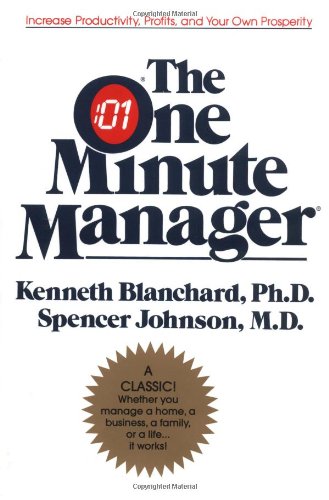
| The One Minute Manager | Kenneth Blanchard and Spencer Johnson | Brand new managers who want a simple routine they can start tomorrow |
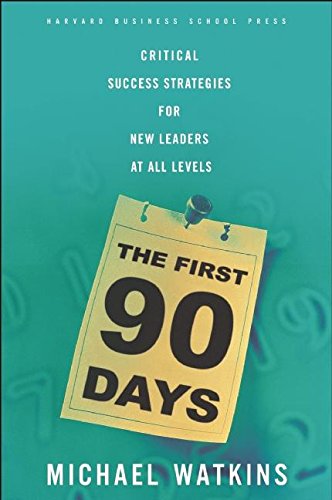
| The First 90 Days | Michael D. Watkins | Anyone starting a new leadership role or promotion |
| Radical Candor | Kim Scott | Managers who avoid tough feedback or deliver it badly |
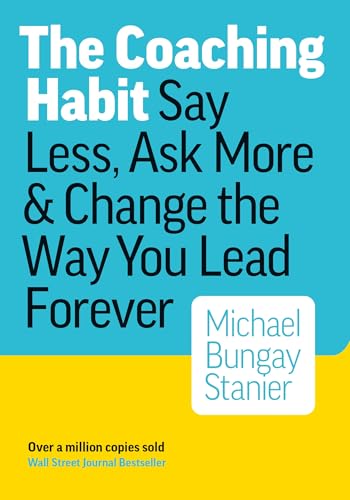
| The Coaching Habit | Michael Bungay Stanier | Busy managers who want to coach in everyday conversations |
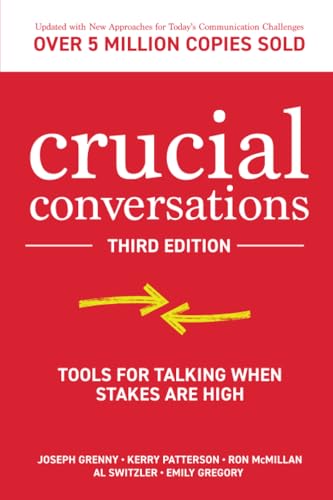
| Crucial Conversations | Kerry Patterson, Joseph Grenny, Ron McMillan and Al Switzler | Managers facing difficult conversations with staff or bosses |
| High Output Management | Andrew S. Grove | New and mid-level managers who like a systematic, numbers-based approach |
| The Effective Executive | Peter F. Drucker | Managers whose diary has taken over |
| First, Break All the Rules | Marcus Buckingham and Curt Coffman | Managers who want an evidence-based view of what great managers do differently |
| The Five Dysfunctions of a Team | Patrick Lencioni | Managers inheriting a team that does not pull together |
| Multipliers | Liz Wiseman | Strong individual performers who now need to grow others |
| Becoming A Strategic Business Leader | Adam Niazi | Managers stepping up to strategic responsibility who want the core models in one place |
What should a first-time manager read first?
In your first few months, you need practical help with the basics: what the job actually is, how to set expectations and how to get through the transition without losing credibility. These three books cover that ground.

1. The Making of a Manager
Julie Zhuo, 2019
Best for: First-time managers in their first yearJulie Zhuo became a manager at Facebook at 25 and writes the guide she wishes she had been given. She explains that management is about three things: purpose, people and process, and then works through the real situations new managers face, from the first awkward one-to-one to hiring, running meetings, giving feedback and managing former peers. The tone is warm and honest, with simple illustrations. It is the friendliest single book for someone who has just been promoted and is quietly worried they will get it wrong.
Key lesson: A manager's job is to get better outcomes from a group of people working together.
View on AmazonIf you only read one book as a new manager, make it this one. Zhuo explains the shift from doing the work to getting results through others better than anyone, and her chapters on the first one-to-ones and managing people who used to be your peers are exactly the situations that cause the most anxiety.
2. The One Minute Manager
Kenneth Blanchard and Spencer Johnson, 1982
Best for: Brand new managers who want a simple routine they can start tomorrowA short parable about a young man searching for an effective manager. The answer is three simple practices: one minute goals (clear, short written goals), one minute praisings (catch people doing something right) and one minute re-directs (prompt, specific correction that separates the behaviour from the person). It can be read in an hour and its simplicity is the point. Experienced managers may find it light, but for new managers it is a memorable starting framework for clear expectations and timely feedback.
Key lesson: Agree clear goals, then praise and correct promptly and specifically.
View on AmazonSome experienced managers dismiss this as too simple, but simplicity is its strength. The three practices (clear goals, prompt praise, prompt correction) are a routine you can start on day one, and many management problems come from skipping exactly these basics.
3. The First 90 Days
Michael D. Watkins, 2003
Best for: Anyone starting a new leadership role or promotionWatkins focuses on the most dangerous moment in a leader's career: the transition into a new role. He explains how to accelerate learning, match your strategy to the situation (start-up, turnaround, realignment or sustaining success), secure early wins, negotiate expectations with your boss, build alliances and avoid common traps. The updated edition keeps the same structure. It is practical and checklist friendly, and it is just as useful for an internal promotion as for joining a new organisation.
Key lesson: Diagnose the situation before you act, and agree what success looks like with your boss early.
View on AmazonWatkins is especially useful if you have been promoted from inside the team, because the temptation is to carry on as before. His advice on agreeing expectations with your own manager early, and securing a couple of visible early wins, prevents many first-year problems.
Which books help with the day-to-day people side of managing?
Once you are settled, most of your week is spent in conversations: one-to-ones, feedback, problem solving and the occasional hard discussion. These three books make those conversations better. For more books organised by individual skill, see my list of leadership skills books.

4. Radical Candor
Kim Scott, 2017
Best for: Managers who avoid tough feedback or deliver it badlyKim Scott, who managed teams at Google and coached leaders at Apple, offers a two-by-two model for feedback: care personally and challenge directly. Doing both is radical candour; challenging without caring is obnoxious aggression, caring without challenging is ruinous empathy, and doing neither is manipulative insincerity. The book then covers how to ask for criticism, give praise, hold one-to-ones and build a culture where feedback flows in every direction. It is one of the most practical books on the everyday conversations that make or break a manager.
Key lesson: Care personally and challenge directly at the same time.
View on AmazonNew managers usually err on the side of being nice and vague, which Scott calls ruinous empathy. Her framework gives you permission to be clear while still caring, and her advice on asking for feedback before giving it is the best way to start.
5. The Coaching Habit
Michael Bungay Stanier, 2016
Best for: Busy managers who want to coach in everyday conversationsA short, practical book built around seven questions, starting with "What's on your mind?" and ending with "What was most useful for you?". The author's argument is that managers give too much advice and ask too few questions, which creates dependence and overwhelm. By staying curious a little longer, leaders help people solve their own problems. The book includes simple habit-building advice, so the questions actually get used. It is ideal for busy managers who want to coach without setting aside formal coaching sessions.
Key lesson: Stay curious a little longer and rush to advice a little more slowly.
View on AmazonThis is the book that will save you the most time. Many new managers become the bottleneck because they answer every question. Bungay Stanier's seven questions help people solve their own problems, which builds their confidence and frees your diary.
6. Crucial Conversations
Kerry Patterson, Joseph Grenny, Ron McMillan and Al Switzler, 2002
Best for: Managers facing difficult conversations with staff or bossesA crucial conversation is one where stakes are high, opinions differ and emotions run strong. The authors show how most people either go silent or turn aggressive at these moments, and they set out skills for staying in dialogue: start with what you really want, notice when safety is at risk, separate facts from the stories you tell yourself, and state your path in a way others can hear. The third edition updates the examples. It is one of the most practical communication books for managers.
Key lesson: When people feel unsafe they stop listening, so restore safety before you continue.
View on AmazonSooner or later you will need to raise a performance problem, push back on your boss or calm a conflict between two team members. This book gives you a tested approach for staying calm and keeping the dialogue going when emotions run high.
Which books help you run a team as a system?
After the people basics, the next step is thinking about your team as a system: where your time goes, which activities have the most leverage and how to build on each person's strengths.

7. High Output Management
Andrew S. Grove, 1983
Best for: New and mid-level managers who like a systematic, numbers-based approachWritten by the former Intel chief executive, this is a manual for treating management as a production process. Grove's central idea is that a manager's output is the output of their team and of the neighbouring teams they influence, so the job is to choose the activities with the highest leverage. He covers one-to-ones, meetings, decision-making, planning, performance reviews and training with an engineer's precision. Some examples are dated, yet the ideas on leverage, indicators and task-relevant maturity remain some of the most practical in the genre.
Key lesson: Your output is your team's output, so spend time where your leverage is highest.
View on AmazonGrove is the book most often recommended by experienced managers in technology and operations, and for good reason. His explanation of one-to-ones (the employee sets the agenda, the manager listens and asks) and his idea of task-relevant maturity (adjust how closely you supervise based on experience with the specific task) are both immediately useful.
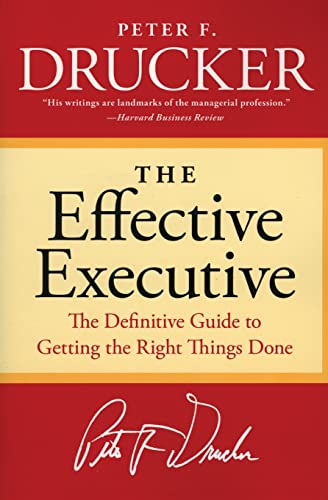
8. The Effective Executive
Peter F. Drucker, 1967
Best for: Managers whose diary has taken overDrucker argues that effectiveness is a set of habits anyone can learn, not a personality trait. He asks knowledge workers to track where their time really goes, decide what contribution they are paid to make, build on strengths (their own and their team's), put first things first, and make a few big decisions well rather than many small ones badly. The book is short and old fashioned in tone, but the core questions still expose why busy managers often achieve little. Reading it is a useful reset whenever your diary has taken over.
Key lesson: Ask "what contribution am I paid to make?" and protect the time to make it.
View on AmazonManagers are pulled in every direction. Drucker's discipline of tracking your time and protecting blocks for important work is the antidote, and his question about contribution keeps you focused on what your organisation actually needs from your team. A simple test: if your calendar for next week has no protected time for planning, coaching or thinking, Drucker would say you are being managed by your diary rather than managing it. Block two hours this week and guard them.
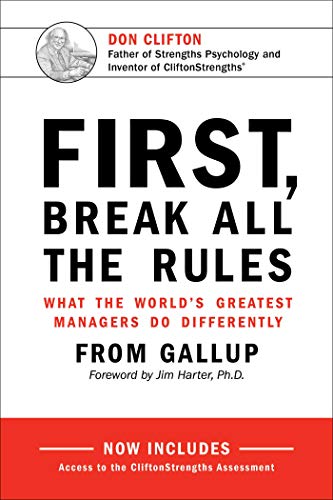
9. First, Break All the Rules
Marcus Buckingham and Curt Coffman, 1999
Best for: Managers who want an evidence-based view of what great managers do differentlyBased on Gallup interviews with tens of thousands of managers, this book argues that the best managers break conventional wisdom. Instead of trying to fix people's weaknesses, they select for talent, define the right outcomes, focus on strengths and find the right fit for each person. It also introduced the twelve questions Gallup uses to measure a strong workplace. The research base is its biggest strength, and it remains a good antidote to the idea that management is about making everyone the same.
Key lesson: Focus on strengths and define outcomes, not steps.
View on AmazonThis book will change how you think about performance reviews and development plans. Instead of trying to fix every weakness, focus on what each person does best and arrange the work around it. It is grounded in Gallup's large-scale research, which makes it persuasive when you need to justify a different approach to HR.
Which books help you build a high-performing team?
A group of capable people is not automatically a good team. These two books tackle the dynamics that hold teams back, including the manager's own behaviour.

10. The Five Dysfunctions of a Team
Patrick Lencioni, 2002
Best for: Managers inheriting a team that does not pull togetherTold as a business fable about a new chief executive and her divided leadership team, the book builds a simple pyramid of team problems: absence of trust, fear of conflict, lack of commitment, avoidance of accountability and inattention to results. Each level depends on the one beneath it, so a team that cannot be open with each other will never argue productively or hold each other to account. The story format makes it quick to read, and the model gives teams a shared language for talking about what is going wrong.
Key lesson: Trust comes first: without it, healthy conflict and accountability never happen.
View on AmazonLencioni's model gives you and your team a shared language for what is going wrong. If meetings are polite but nothing changes, you probably have a trust or conflict problem rather than a skills problem.
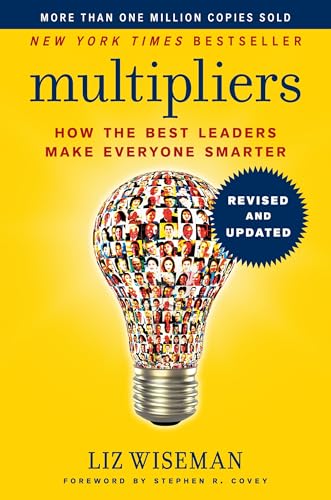
11. Multipliers
Liz Wiseman, 2010
Best for: Strong individual performers who now need to grow othersLiz Wiseman, a former Oracle executive, contrasts two kinds of leaders. Diminishers drain intelligence from their teams by deciding everything, micromanaging and holding the best ideas for themselves. Multipliers draw out more capability than people knew they had, by attracting talent, setting stretching challenges, debating decisions and giving ownership. The revised edition adds the idea of the "accidental diminisher": the well-meaning leader whose helpfulness quietly shrinks the team. It is a sharp mirror for any capable manager who struggles to let go.
Key lesson: The best leaders make everyone around them smarter and more capable.
View on AmazonThis is the book for the manager who was the best performer on the team and now cannot stop doing the work. Wiseman's "accidental diminisher" profiles are uncomfortable to read but very helpful.
Which book helps managers think more strategically?
At some point, being good at running your team is not enough. You are asked to contribute to strategy, budgets, risk discussions and change programmes. That is the move from operational to strategic leadership, which I explain in my guide to strategic vs operational leadership.
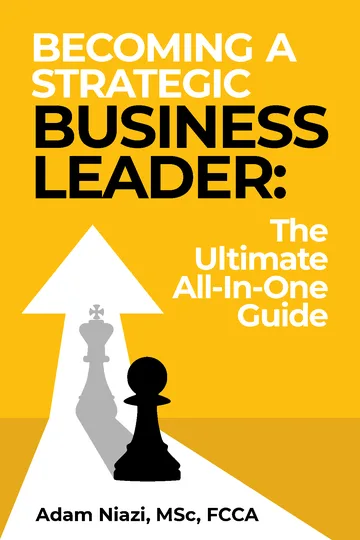
12. Becoming A Strategic Business Leader: The Ultimate All-In-One Guide
Adam Niazi, 2023
Best for: Managers stepping up to strategic responsibility who want the core models in one placeA concise guide to the core strategy, governance and leadership models, originally written for the ACCA Strategic Business Leader (SBL) exam and useful for any manager who wants the big frameworks in one place. Its 19 short chapters run from strategic analysis and choice through governance, stakeholders, leadership, risk, ethics, project management and managing change, so you can see how leadership fits into the wider job of running an organisation. It is a revision-style summary rather than a story-led read. Disclosure: this is my own book.
Key lesson: Leadership only works when it is tied to strategy, governance, risk and the way change is managed.
View on Amazon Read 3 chapters freeI have put my own book last because it suits the later stage of a manager's development rather than the first months. It is a concise guide to the core strategy, governance and leadership models, originally written for the ACCA Strategic Business Leader exam. Managers who are starting to sit in strategy or budget meetings tell me it is useful for understanding the frameworks other people use, such as PESTEL, the Ansoff matrix and stakeholder mapping.
Which management book suits your situation?
| Situation | Read | Why |
|---|---|---|
| First week as a manager | The Making of a Manager | Explains what the job really is |
| Promoted over former peers | The First 90 Days | Helps you reset expectations and relationships |
| Avoiding feedback conversations | Radical Candor | Gives you a kind but direct approach |
| Team brings you every problem | The Coaching Habit | Helps people solve their own problems |
| Performance problem to address | Crucial Conversations | Keeps a tense conversation productive |
| Always busy, never on the important things | The Effective Executive | Shows where your time is going |
| Team does not work well together | The Five Dysfunctions of a Team | Diagnoses trust and conflict problems |
| Asked to contribute to strategy | Becoming A Strategic Business Leader | Summarises the core models in one place |
What do new managers get wrong most often?
In my experience, the same handful of mistakes come up again and again, and each one has a book that addresses it.
- Carrying on doing the old job. It feels productive, but it leaves no time to manage. Zhuo and Wiseman both tackle this directly.
- Being vague to stay liked. Unclear feedback feels kind but leaves people guessing. Scott and Patterson show a better way.
- Treating everyone the same. People need different levels of direction and support for different tasks. Grove's task-relevant maturity and the situational leadership idea both help here; see my guide to situational leadership.
- Answering every question. It makes you the bottleneck and stops your team developing. The Coaching Habit is the fix.
- Not agreeing expectations upwards. Many new managers never ask their own boss what success looks like. Watkins makes this a priority.
Are books enough, or do managers need training too?
Books are the cheapest and most flexible way to learn management, but they work best alongside practice and feedback. The Center for Creative Leadership highlights four skills that matter at every career stage, self-awareness, communication, influence and learning agility (CCL), and none of those improves by reading alone. A good pattern is to combine a book with a real situation: read Crucial Conversations the week before a difficult review, or The Coaching Habit before a run of one-to-ones, then ask a trusted colleague how it went. If your organisation offers a management course or a mentor, the books on this list make that training stick, because you arrive with a shared vocabulary and specific questions.
It also helps to know that no single style works everywhere. Daniel Goleman's research found that the most effective leaders switch between several styles depending on the situation (Harvard Business Review). Reading widely gives you more options to switch between.
How can you use these books with your team?
Some of the most useful management books work even better when the whole team reads them. The Five Dysfunctions of a Team and Radical Candor in particular give everyone a shared language. Try choosing one book a quarter, asking each person to bring one idea they want the team to try, and agreeing one change together. For example, after reading Radical Candor a team might agree that everyone asks for one piece of feedback each week. It turns reading from a private habit into a team habit, and it shows that you are learning too.
How I chose these
I chose books that answer the practical questions managers actually ask, rather than the most famous leadership titles. Each book had to give specific techniques you can use this week, be suitable for managers in any sector, and either rest on solid research or come from deep management experience. I deliberately included a mix of short and long reads, and ordered them by when most managers will need them. For a wider list that also covers strategy and change, see my best leadership and management books.
Where my book fits for managers
Becoming A Strategic Business Leader is not a first-week manager's guide, and I would not hand it to someone in their first month. Where it helps is the next step: when a manager starts working on strategy, governance, risk or change. Chapter 8 covers leadership theories and styles, Chapter 14 organisational structure, Chapter 17 project management and Chapter 19 managing change. You can read the first three chapters free here.
Bottom line
Start with The Making of a Manager, add Radical Candor and The Coaching Habit in your first six months, and read High Output Management once you are ready to think about your team as a system. Those four books cover most of what new managers need. Then choose the rest based on the problems you meet. If you are building a longer development plan, see my list of leadership development books.
FAQs
What is the best book for a new manager?
The Making of a Manager by Julie Zhuo is the best single book for a new manager. It covers the situations new managers worry about most, including first one-to-ones, giving feedback, hiring and managing former peers, in a practical and honest way. Pair it with Radical Candor for feedback and The Coaching Habit for everyday coaching.
What books should every manager read?
Every manager benefits from The Making of a Manager, High Output Management, Radical Candor, The Coaching Habit and The Five Dysfunctions of a Team. Together they cover the job itself, running the team as a system, feedback, coaching and team dynamics. Add The Effective Executive if time management is your main struggle.
Is High Output Management good for new managers?
Yes, but it is better in your second or third month than your first week. Andrew Grove's book is precise and demanding, covering one-to-ones, meetings, decisions and performance reviews. Read a gentler introduction such as The Making of a Manager first, then use Grove to build a more systematic approach.
How can I become a better manager quickly?
Focus on three habits: hold regular one-to-ones where your team member sets the agenda, give specific feedback promptly, and ask questions before offering advice. These come from High Output Management, Radical Candor and The Coaching Habit. Agree clearly with your own boss what success looks like in your first months.
What is the difference between a leadership book and a management book?
Management books focus on running work reliably: planning, organising, one-to-ones, performance and time. Leadership books focus on direction, trust, motivation and change. Managers need both, which is why this list mixes them. Early on, management basics matter most; leadership and strategy become more important as you progress.